Take the art map on your next trip to NorthPark
NorthPark’s collection makes it possible to fit a sculpture walk around a regular shopping trip.
In this article
The next time you go to NorthPark to buy something or meet someone, come with the names of three artworks you would like to find. Pick them from the center's map and make one of them the reason to take a longer way through a court. This is an unusually easy way to spend time with sculpture in Dallas. The works are installed along distances people already walk, and you can decide whether to give them five minutes or an hour once you see how they fit into the rest of the trip.
Start with NorthPark Center's art collection page. It offers a virtual tour and directs visitors to a complimentary art map at the concierge on Level One near Neiman Marcus. The site describes works from the Nancy A. Nasher and David J. Haemisegger Collection alongside loans from the Nasher Sculpture Center. Installations and temporary displays can move. Take the latest map from the center or ask about a particular work if your visit depends on finding it.
Choose a route short enough to leave time for looking
For a first visit, pick one stop where you will spend more time and two that are easy to reach on either side of it. Give each person in the group one say in what you go to see. A child might choose a familiar figure, while someone else wants to look at color or a piece that stands out against the architecture. Locate the choices on the map before choosing an entrance and jot down their levels. An artwork that looks near another on a phone screen may require a different corridor or another level. Plan around the landmarks the group can identify once it is inside.
Use the center's illustrated art map to see how an art route can be built around courts, the garden and the two levels. That edition gives artists, titles, dates, materials and locations. Keep it as a reference for the kinds of works shown. The concierge's latest information is what matters for a piece you mean to see on a particular afternoon. If the gallery list and a physical label differ, use the label as your record of what you actually saw.
Agree where the trip needs to end. If you are collecting an order or meeting somebody for lunch, put the last artwork near that destination. A family with a stroller or a visitor choosing a route for a mobility device can use the directory and ask the concierge about elevators and any current approach changes. One court with two good views can be a more manageable plan than visiting every marked location. Keep the longest pause at a place where others can continue passing.
Compare movement, color and material
The center's illustrated map includes Jonathan Borofsky's *Five Hammering Men* from 1982. Its material list includes painted wood, metals and electric motors. The arrangement offers a way to think about repetition. Look at the figures individually and then as a group. Are their poses interchangeable at first glance? Look from a side where they appear to overlap and then from farther away. A large space gives the figures room to seem almost independent. Their repetition becomes clearer as you move and see where each lands in the overall arrangement.
Roy Lichtenstein's *Double Glass*, from 1976, provides a different question. The title suggests one material, while the center's map describes it as painted bronze. Take a moment to look at which colored lines and edges create the impression that parts of the structure are divided. Then look through the spaces between forms and see which part of the background becomes visible. The way you approach can change your understanding of the work before you read the material description. If it is not on view, choose another sculpture with openings or painted surfaces and try the same comparison.
Thomas Houseago's *Untitled (Standing Figure)*, from 2012, is also listed as bronze. The texture shown in the center's guide is quite different from the painted surfaces in the Lichtenstein. If both pieces are on view, spend one stop considering what the finish does. Focus on the edges of a form, the shadows created by irregular surfaces and how the piece separates visually from its setting. A visitor who pays attention to the surface may come away with a better sense of what the same base material can do in the hands of different artists.
Those works are options, and the person with the map can give the group's own choices just as much attention. With a child, ask them to pick one question before anyone reads the label. A useful one is whether they could recognize the work by a detail photographed from a different angle. You can also ask how they would describe the piece using only a shape and an action, or what feature made them slow down while they were walking past its court. A good answer can be brief, specific and entirely their own.
Use the building to change your angle
NorthPark was opened in 1965 by Raymond and Patsy Nasher, according to the Nasher Sculpture Center's account of its offsite collection. The architectural practice OMNIPLAN describes how art fits into NorthPark's corridors and courts. When you enter an open court, take a few seconds to see what has been placed there and how much air there is around it. A long view down a passage lets a visitor encounter a silhouette at one scale and then see details at walking distance. Moving closer changes the relationship between the object, the wall, the ceiling and the people around it.
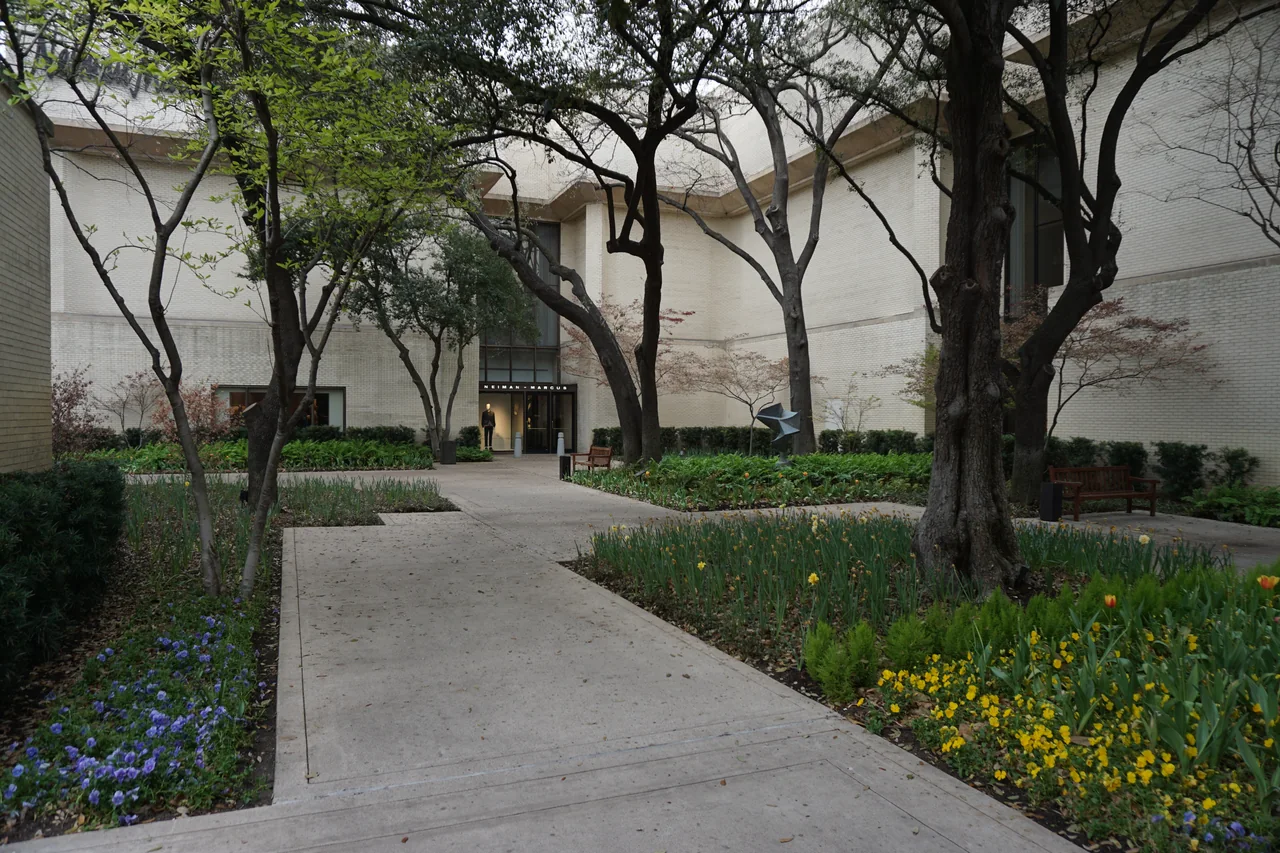
The March 2017 photograph above shows an exterior route with planting, a walkway and NorthPark's light brick. It records an approach to the building, and its date matters because the center and its installations evolve. When you go inside today, pay attention to one view of a work with the building present around it. A staircase, railing or change in ceiling height can be a useful part of the picture. You can look from another public level only if the view is easy to reach and there is a safe place to stand clear of the flow of foot traffic.
The same piece can draw the eye differently when approached during a weekday errand and on a busy weekend. If the court is congested, choose a spot near the edge, read from a comfortable distance or move on and return when there is more room. Resist the temptation to use a display base or a planter as a place to stand. A pair of quick observations can be more memorable than a photograph made in the middle of a crowd. For photography where you plan to set up equipment or use images commercially, ask the center about its applicable rules in advance.
Let a label answer one question and raise another
Once you have seen an object in context, look at its name and material. A line of small type can resolve something that was genuinely difficult to tell from a distance. Write down the artist, date and a detail you saw. For instance, a person who noticed a reflection in a polished area can record what the reflection included when they stood at a particular angle. If someone else read the same work as heavier or lighter than expected, note what led them there. These short descriptions are useful next time because they point back to a specific object and location rather than a broad impression.
The next stop might be in another court or on another day. If you have one more destination in the center, follow the route that serves that part of the trip. The experience works even when you see fewer objects. Add a fourth stop only if someone has time to give it the same attention. A friend who will visit later can use your notes to search the collection, find a view that interested you and make their own comparison. Keep the latest location information from the concierge apart from the date and material details you use to identify the work.
Read the date carefully when a piece belongs to a series. Two works with similar names may have different materials, scales or relationships to the places they are shown.
Follow a work out into the city
The Nasher's offsite listings place NorthPark alongside another public venue, Dallas Fort Worth International Airport, and explain that offsite art allows the collection to reach people in ordinary settings. Its Nasher Public program offers a separate way to learn about contemporary work in North Texas. Use those pages to follow up if you came away curious about what happens when art is placed along a daily route. If you want to see one particular work again, start by checking its title and where it is showing before you plan a separate trip.
For the next visit to NorthPark, bring back one of the questions from this one. See what a different sculpture does with color, what you can recognize from across a court or what changes once you know the material. Beginning with something specific makes the collection easier to fit into the time you actually have. For other local visits built around what you can look at closely, see Arts & Culture.
Sources
- NorthPark Center's art collection pagenorthparkcenter.com
- center's illustrated art mapmallmaverick.imgix.net
- Nasher Sculpture Center's account of its offsite collectionnashersculpturecenter.org
- OMNIPLAN describes how art fits into NorthPark's corridors and courtsomniplan.com
- Nasher Public programnashersculpturecenter.org